Hinton Cabin
The Hinton Cabin was the first to be reconstructed at the newly-dedicated Village Site – a 33 acre plot of woods and pasture on the Chuck Poehlein Farm. According to Mary Hinton Wallenmeyer, one of five Hinton Children born in the cabin, it was first occupied by the Carter’s. Mary said both the Hinton Cabin and Carter Cabin were built in 1854 by the same people – hear Great Grandfather Homer Hull Carter and Homer’s brother Bill. The two cabins are remarkably similar in structure and size. Both had a lean to building added to the log structure.
The cabin was located on Zion Road south of Deer Creek Baptist Church and was owned by Kenneth and Helen Hinton. Kenneth is a descendant of the Carter Family. The Hinton Cabin and Carter Cabin were located just a half a mile apart, The Carter Cabin being on the John Moore Farm. Until construction of the Hinton’s new home in the 1920’s, the small cabin faithfully served as a family homestead for the better part of a century. Mary said her father was born in 1879 and he settled at the Carter/Hinton Cabin when he married Rosa Anderson.
Some members of both the Carter and Hinton clan hold to the tradition that Native Americans helped build the cabins. That can neither be proved or disproved.
The last generation born in the cabin include Mary Hinton Wallenmeyer of Tell City, Freida Hinton Seabolt of Sun City, AZ, Alice Hinton Criss of Lamar, Lucile Hinton Kelly of Tell City, and Ruth Hinton Huff of Tell City. These Hinton’s gathered at the cabin for it’s dedication in 2000. It was primarily through the efforts of Mary Hinton Wallenmeyer that the cabin was saved and reconstructed at the Shubael Little Pioneer Village.
Cabin Reconstruction
Hinton Cabin was given to the Perry County Museum by Kenneth and Helen Hinton (Now Deceased) in 1998. We had advertised in the community for a donation of a cabin to reconstruct and the Hinton’s were the first ones to contact us. Actually, it was Mary Hinton Wallenmeyer, one of the Hinton children born in the cabin, who wanted it preserved. None of the other family members were very much interested.
The logs were numbered and the cabin was taken down by Lee Litherland and Chuck Poehlin, working in early winter in a mud lot of a pasture. Tim Huff loaned us a tractor with a forklift. The logs were stored at the village site, picked out by CP until the Spring of 1999 when a crew consisting of Rodney Covey, Gary Dauby, Gary Johnson, Bob Ramsbottom, and Chuck Poehlin got together one sunny day to begin the reconstruction. We depended wholly the expertise of Johnson, who was the only knowledgeable of how to refit “new” replacement logs for the ones that had rotted away and place the cabin on the new foundation logs prepared by CP. These were two whole white oak trees Poehlin had sawed down near the site and squared with a chainsaw, a feat he vowed never again to duplicate.
Covey rigged a pipe with chains on his forklift tractor for a makeshift crane and that is what we used to hoist the logs for the walls, locking the top plates with iron pins. CP worked on the cabin for several months refitting the doors and windows with new oak timbers from Bebco Hard Woods of Troy. Chuck installed the original ceiling joists and the original poplar roof rafters by himself and nailed 1,030 split-cedar shingles purchased from Chris Ramsey. The cabin could not have been completed without a gift of $1,000 from Lucile Schergens for the purchase of the shingles and new poplar roof sheeting.
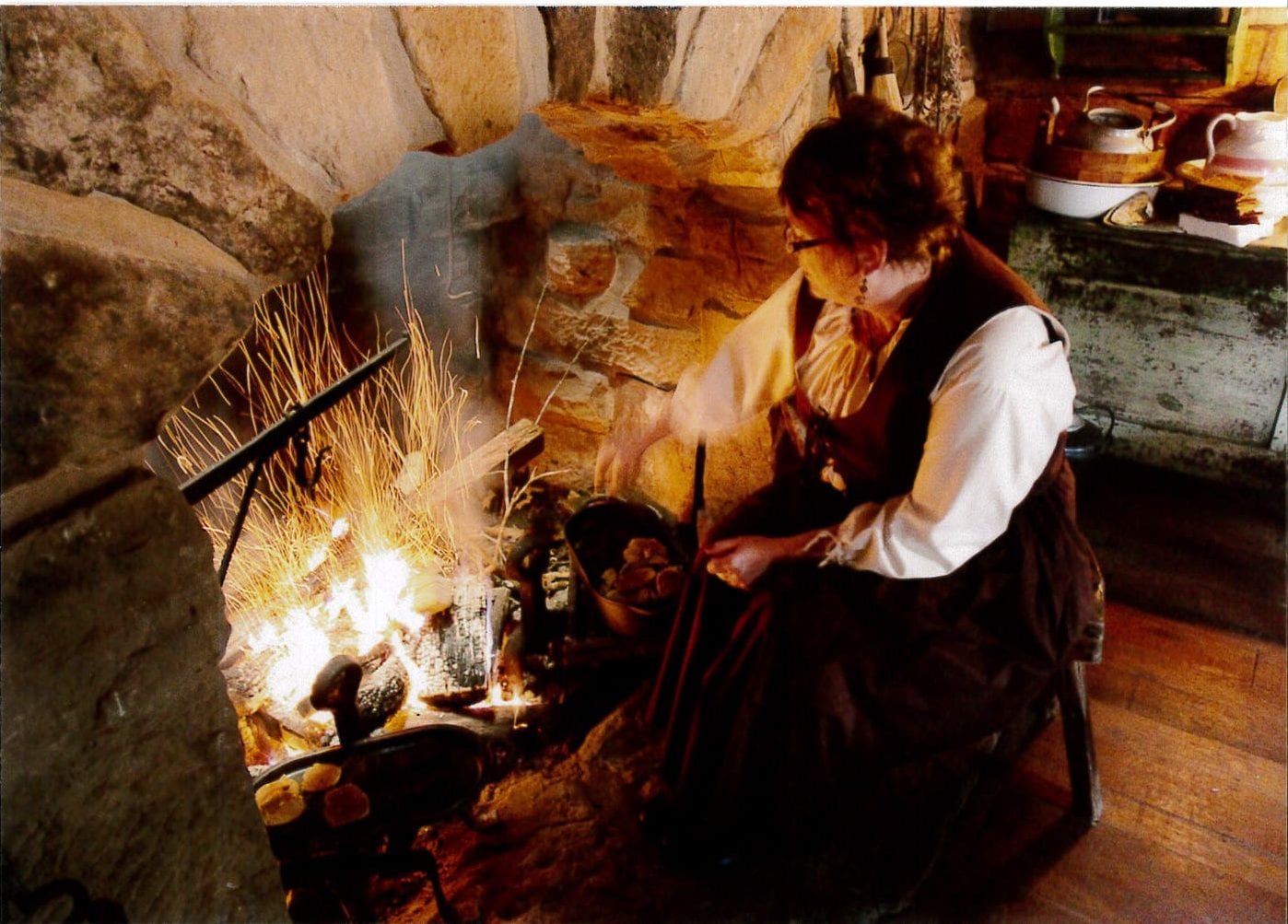
Next, Covey and Poehlin pressure washed all the original poplar boards from the attic floor and washed the oak boards for the gable ends, most of which were original in the restored cabin. We pressure washed the interior logs. Brick mason Rick Simpson began work on the fireplace one Saturday in December with Poehlin acting as a go-fer. Simpson completed the fireplace and chimney in four and a half Saturdays. No trace of the original fireplace remained. When we found the cabin, cows were walking in the front door and out the back, the ground floor having completely disappeared. There were a few remains of the stairway. CP made a shelf from two of the steps. This shelf is now hanging on a wall of the cabin.
The fireplace is built in a style common to this area 150 years ago. Simpson received $200 expense money from Mary Wallenmeyer. Foundation Stones were donated by Dave and Thelma Thompson. Additional stones were donated by Michael Rutherford, Rudy Howser, and Karen and Bob Hafele. The fine antique crane was donated by Evelyn and David Adams and came from an old house torn down on their property. The engraving on the marker stone was donated by Ron Crawford Family Memorials. Many others contributed furnishings to the cabin. Their names are listed elsewhere.
Hinton News Story
When Homer Hull Carter and William Carter set out to build a log home in Perry County wilderness of 1840, little did they know that the giant yellow poplar trees they set their axes against would survive into the 21st Century.
Today, 150 years later, the homestead the Carters crafted with their own hands still stands as a testament to the determination of the county’s pioneer families. Now, thanks to the generosity of its owners and planning of county historians, the log home steeped in the Heritage of Perry County will soon become the centerpiece of a new historical display.
Located on Zion Road south of Deer Creek Baptist Church, the log cabin is owned by Kenneth Hinton, a descendent of the Carter Family. Until construction of the Hinton’s existing home in the 1920’s, the small cabin faithfully served as the family homestead for the better part of a century.